Buying guide
Internal vs external penetration test: choosing the right starting point
The internal vs external penetration test question is about where the test starts. An external test starts from the internet, while an internal test starts from inside your network.
- Named tester before day one
- One retest within 30 days
- OWASP WSTG and NIST SP 800-115
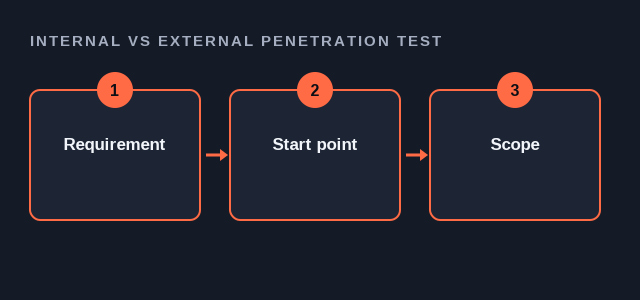
Internal vs external penetration test in one sentence each
An external test looks at the systems anyone on the internet can reach. An internal test looks at what a person or device already inside the network could reach.
So they answer different questions. One asks what is exposed to the world. The other asks how far a problem inside could spread.
Who asks for each test
Customers and investors usually ask about external exposure first. However, some frameworks and auditors also expect internal testing. So check the exact wording of the requirement.
For example, PCI DSS requirement 11.4 asks for both internal and external testing at least annually. Therefore, a merchant or service provider in scope usually needs both.
| Question | External | Internal |
|---|---|---|
| Starting point | The internet | Inside the network |
| Typical requester | Customers, investors | Auditors, frameworks |
| Access needed | Usually none | A connection point |
| Preparation | Light | More planning |
Internal vs external penetration test check
Tick each statement that is true for you.
Your result appears here as you tick, so you can see what is still open.
Effort and fee drivers
External scope is counted in public addresses and services. Internal scope is counted in address ranges, sites and segments. Because internal networks are often larger, internal tests usually take more days.
Also, an internal test needs access arranged in advance. That adds preparation time on your side.
Doing both: internal vs external penetration test together
Many buyers run both in one engagement. One scope, one statement of work and one report keep the paperwork simple. In addition, the tester sees the whole picture.
If the budget allows only one this year, start with the test the requester asked for. Then plan the other for the next cycle.
Reading the internal vs external penetration test reports
External findings tend to need fast fixes because anyone can reach them. Internal findings often point to wider design questions. So plan remediation differently for each.
Also keep the two sets separate in your tracker. Auditors may ask for them separately.
Where Halberd helps
We quote external and internal testing in one fixed fee when both are needed. Our quotes are fixed fees inside the published ranges, and most companies land between $10,000 and $30,000. Each one includes manual testing by a named practitioner, a report with proof and fixes, an attestation letter and one retest inside 30 days. The method follows NIST SP 800-115 and the OWASP Web Security Testing Guide.
Internal vs external penetration test questions
Which comes first in an internal vs external penetration test plan?
Usually the one your requester asked for. Otherwise, external is the common starting point.
Is an internal vs external penetration test done remotely?
External testing is remote. Internal testing is often remote too, through an agreed connection point.
Does PCI DSS need both?
Requirement 11.4 asks for internal and external testing at least annually.
Can one report cover both?
Yes, with the findings clearly separated.
Related guides
Decide internal vs external penetration test scope
Answer four scoping questions on our home page. You receive a written estimate, usually within four working hours.
Get my estimate