Buying guide
A penetration test for due diligence, from request to data room
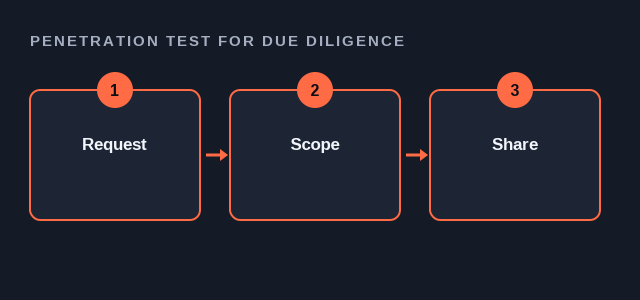
A penetration test for due diligence answers a specific question from an investor or acquirer. So the scope, the timing and what you share all follow from that request.
- Named tester before day one
- One retest within 30 days
- OWASP WSTG and NIST SP 800-115
Why investors ask for a penetration test for due diligence
Investors and acquirers want to know what risk they are buying. A recent independent test is one piece of evidence they can read quickly. As a result, it often appears on the due diligence request list.
Also, the request may arrive late in the process. So companies that expect a funding round often schedule a test in advance.
Reading the request carefully
Check what the request actually asks for. Some want a full report. Others want only a summary, an attestation letter or confirmation that findings were fixed.
In addition, check the time frame. A request for a test within the last twelve months is common, but the exact wording decides.
| Request wording | What usually answers it |
|---|---|
| Recent independent test | Attestation letter and executive summary |
| Findings and status | Retest report or remediation record |
| Full report | Report shared under confidentiality terms |
| Scope confirmation | The signed scope page |
Penetration test for due diligence check
Tick what you already have for the data room.
Your result appears here as you tick, so you can see what is still open.
Scoping a penetration test for due diligence
Focus the scope on what the investor cares about. Usually that is the main product and the systems that hold customer data. Then add anything named in the request.
Also keep the scope document. Because the reader will ask what was tested, the scope page is often shared alongside the summary.
Timeline under deal pressure
Deals move fast, but testing and fixes take time. So plan backwards from the data room date. Remember that testers may be booked weeks ahead.
In addition, leave room for the retest. A report with closed findings reads far better than one with open ones.
What to share from a penetration test for due diligence
Share the least that answers the question. Often that is the attestation letter, the executive summary and the retest status. Then offer the full report under confidentiality terms if asked.
Also record who received what and when. That record matters if the deal does not close.
Where Halberd helps
Each engagement includes an attestation letter for third parties and one retest inside 30 days, so the data room can show closed findings. Our quotes are fixed fees inside the published ranges, and most companies land between $10,000 and $30,000. Each one includes manual testing by a named practitioner, a report with proof and fixes, an attestation letter and one retest inside 30 days. The method follows NIST SP 800-115 and the OWASP Web Security Testing Guide.
Penetration test for due diligence questions
How recent should a penetration test for due diligence be?
Often within the last twelve months, but follow the request wording.
Should we share the full report?
Usually only if asked, and under confidentiality terms.
Can an older test be used?
Sometimes, if nothing major changed and the findings were fixed.
How long does a penetration test for due diligence take?
Plan several weeks including booking, testing, fixes and the retest.
Related guides
Book a penetration test for due diligence
Tell us your data room date. We reply with a written estimate and dates, usually within four working hours.
Get my estimate