Buying guide
Penetration testing in production or in staging: how to decide
Penetration testing in production gives the most realistic result, while staging gives the most control. The right choice depends on the requester, the risk and how close staging is to the real system.
- Named tester before day one
- One retest within 30 days
- OWASP WSTG and NIST SP 800-115
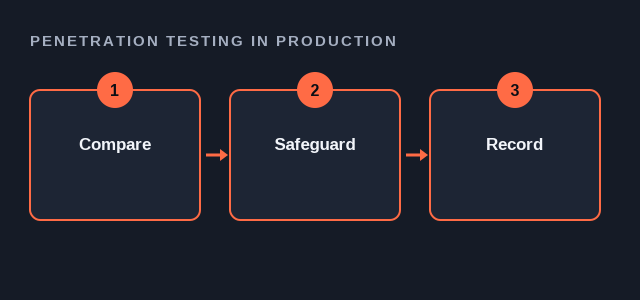
The case for penetration testing in production
Production is the system your customers use. So a test there reflects the real settings, data flows and integrations. Auditors and customers often value that realism.
However, production carries operational risk. Therefore, testing there needs safeguards agreed in writing before day one.
The case for staging
Staging lets testers work without affecting customers. It also allows test data instead of real data. As a result, many buyers prefer it for the first test.
The weakness is drift. If staging differs from production, findings may not match reality. So confirm how closely the two match.
| Question | Production | Staging |
|---|---|---|
| Realism | Highest | Depends on parity |
| Operational risk | Needs safeguards | Lower |
| Data | Real data, handled carefully | Test data |
| Requester view | Often preferred | Accepted if it matches |
Penetration testing in production check
Tick each safeguard already agreed.
Your result appears here as you tick, so you can see what is still open.
Safeguards for penetration testing in production
Agree a testing window outside busy hours. Then confirm backups and name a person who can pause testing. Also exclude any action that could change or delete customer data.
In addition, tell the team that monitors the system. Because they know the test is planned, they can tell it apart from a real incident.
Writing the choice into the scope
State the environment in the signed scope. If staging is used, note how it compares with production. Then the report reader understands what the results cover.
Also record any exclusions that follow from the choice. For example, payment steps that only run in production.
Reading results from penetration testing in production
Findings from production apply directly. So prioritize them by exposure and fix them in your normal release process.
If testing ran in staging, check each finding against production before closing it. A fix in staging alone does not close the issue.
Where Halberd helps
We help you choose the environment during scoping and write the safeguards into the signed scope. Our quotes are fixed fees inside the published ranges, and most companies land between $10,000 and $30,000. Each one includes manual testing by a named practitioner, a report with proof and fixes, an attestation letter and one retest inside 30 days. The method follows NIST SP 800-115 and the OWASP Web Security Testing Guide.
Penetration testing in production questions
Is penetration testing in production safe?
With agreed safeguards, a planned window and a pause contact, it is common practice.
Will auditors accept a staging test?
Often, if staging closely matches production. Check the requester's wording.
Can we test both?
Yes. Some buyers test staging first and production for selected areas.
Does penetration testing in production affect customers?
It should not, which is why the window and exclusions matter.
Related guides
Plan penetration testing in production safely
Answer four scoping questions on our home page. We write the environment and safeguards into the signed scope.
Get my estimate