Buying guide
Scoping a penetration test before you ask for a quote
Scoping a penetration test is the buyer's first job, and it shapes everything after it. The scope decides the fee, the dates, the people involved and what the final report can say.
- Named tester before day one
- One retest within 30 days
- OWASP WSTG and NIST SP 800-115
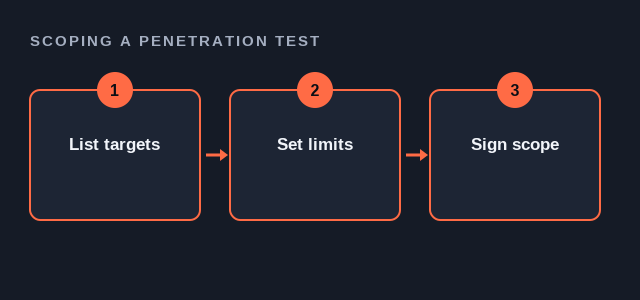
Why scoping a penetration test comes first
A quote is only as accurate as the scope behind it. If the list of targets is vague, two firms will price two different jobs. As a result, the cheaper quote often covers less, and nobody notices until the report arrives.
Also, the scope is the legal boundary of the work. Testing needs the owner's written authorization, so the signed scope is what makes the engagement lawful. Anything outside it stays untouched.
What the scope document lists
Most scope documents answer the same questions. Which systems are in, and which are out? Also, what environment will be used? And who owns each system that appears on the list? Scoping a penetration test means answering all four in writing.
In addition, the scope names the reason for the test. For example, a customer request, an auditor's requirement or an investor's review. Because the reason sets the depth, it belongs on the first page.
| Scope item | What the buyer writes down |
|---|---|
| Targets | Applications, APIs, networks or cloud accounts, each named |
| Exclusions | Systems and data that must not be touched |
| Environment | Production, staging or a dedicated copy |
| Owners | The person who authorizes each system |
| Window | Dates and hours when testing may run |
| Purpose | The auditor, customer or investor asking for it |
Scoping a penetration test checklist
Tick each item that is already written down.
Your result appears here as you tick, so you can see what is still open.
Scoping a penetration test without surprises
Write the scope both ways: what is included and what is excluded. Vague edges are how budgets drift and timelines slip. So name third-party services too, because some providers require their own approval first.
Then count what drives effort. For an application, that means user roles and major features. For a network, it means address ranges and locations. These counts let a firm estimate hours honestly, so scoping a penetration test well also makes quotes comparable.
Who should be involved
Usually three people shape the scope. The technical owner knows the systems. The compliance owner knows what the auditor or customer asked for. Finally, a budget holder signs the order.
Also invite whoever runs operations for the systems in scope. They know the change calendar, the busy periods and the backups, so they help pick a safe window.
Common mistakes when scoping a penetration test
The first mistake is scoping to the budget instead of the requirement. A smaller scope is fine, but only if it still covers what the requester asked for. Otherwise, you pay twice.
The second mistake is leaving the scope unsigned. A scope agreed in an email thread is easy to dispute later. Therefore, keep one signed version and attach it to the order.
Where Halberd helps
Answer four scoping questions on our home page and we return a written estimate, usually within four working hours. A named tester is confirmed before day one. Our quotes are fixed fees inside the published ranges, and most companies land between $10,000 and $30,000. Each one includes manual testing by a named practitioner, a report with proof and fixes, an attestation letter and one retest inside 30 days. The method follows NIST SP 800-115 and the OWASP Web Security Testing Guide.
Questions about scoping a penetration test
How long does scoping a penetration test take?
Often a few days of internal work. Most of it is collecting system lists and confirming owners.
Who signs the scope?
Someone with authority over every system in it, plus the testing firm.
Can the scope change after signing?
Yes, but in writing. A change usually means a revised quote and new dates.
Is scoping a penetration test different for compliance?
The steps are the same. However, the requirement you must meet sets the minimum scope.
Related guides
Start scoping a penetration test today
Answer four scoping questions on our home page. You receive a written estimate, usually within four working hours.
Get my estimate