Buying guide
The penetration testing statement of work, clause by clause
A penetration testing statement of work turns a quote into an agreed job. It records what will be tested, when, by whom and what you receive at the end.
- Named tester before day one
- One retest within 30 days
- OWASP WSTG and NIST SP 800-115
What a penetration testing statement of work is for
The quote tells you the price. The statement of work, however, tells you what that price buys. So it is the document you return to when a question comes up mid-engagement.
It usually sits under a master agreement or standard terms. The master agreement covers liability and confidentiality, while the statement of work covers this one job.
The sections most buyers expect
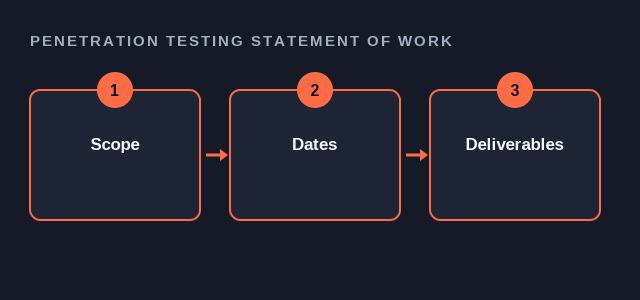
Most statements of work follow a similar order. First the scope and exclusions. Then the schedule, the people, the deliverables and the fee.
Also check that each section refers to the signed scope rather than repeating it loosely. Two slightly different target lists in two documents cause disputes.
| Section | What it should say |
|---|---|
| Scope | Named targets and exclusions, referencing the signed scope |
| Schedule | Start date, testing days and report date |
| People | Named tester and the buyer's contacts |
| Deliverables | Report, attestation letter, retest |
| Fee | Fixed amount and payment terms |
| Changes | How scope changes are priced and approved |
Penetration testing statement of work check
Tick what your draft already covers.
Your result appears here as you tick, so you can see what is still open.
Deliverables in the penetration testing statement of work
Name every deliverable and its format. For example, a full technical report, an executive summary, an attestation letter for third parties and a retest report. Then add a date for each.
In addition, state how findings are rated and how proof is shown. Because auditors read the report closely, the buyer should know in advance what it will contain.
Roles and contacts
The statement of work should name the tester, the firm's project contact and your own contacts. Your side usually needs a technical contact and an escalation contact.
Also agree how urgent findings are reported. A critical issue found on day two should not wait for the final report. So write down who is told, how and within what time.
Reviewing a penetration testing statement of work
Read it next to the quote and the scope. Check that the dates are realistic, that the retest window is stated and that exclusions match. Then ask about anything that is missing rather than assuming it.
Finally, confirm who signs on your side. Because the document authorizes testing, the signer needs authority over every system listed.
Where Halberd helps
Every engagement starts with a written scope and a statement of work that lists the deliverables and dates. Our quotes are fixed fees inside the published ranges, and most companies land between $10,000 and $30,000. Each one includes manual testing by a named practitioner, a report with proof and fixes, an attestation letter and one retest inside 30 days. The method follows NIST SP 800-115 and the OWASP Web Security Testing Guide.
Penetration testing statement of work questions
Who writes the penetration testing statement of work?
Usually the testing firm, based on your scope. You review and sign it.
Does a penetration testing statement of work replace a contract?
No. It normally sits under a master agreement or standard terms.
Should the retest be in the statement of work?
Yes. State whether it is included and the window for it.
How long is a penetration testing statement of work?
Often two to five pages. Length matters less than clear scope and dates.
Related guides
Get a penetration testing statement of work drafted
Answer four scoping questions on our home page. We reply with a written estimate, then a statement of work to sign.
Get my estimate